
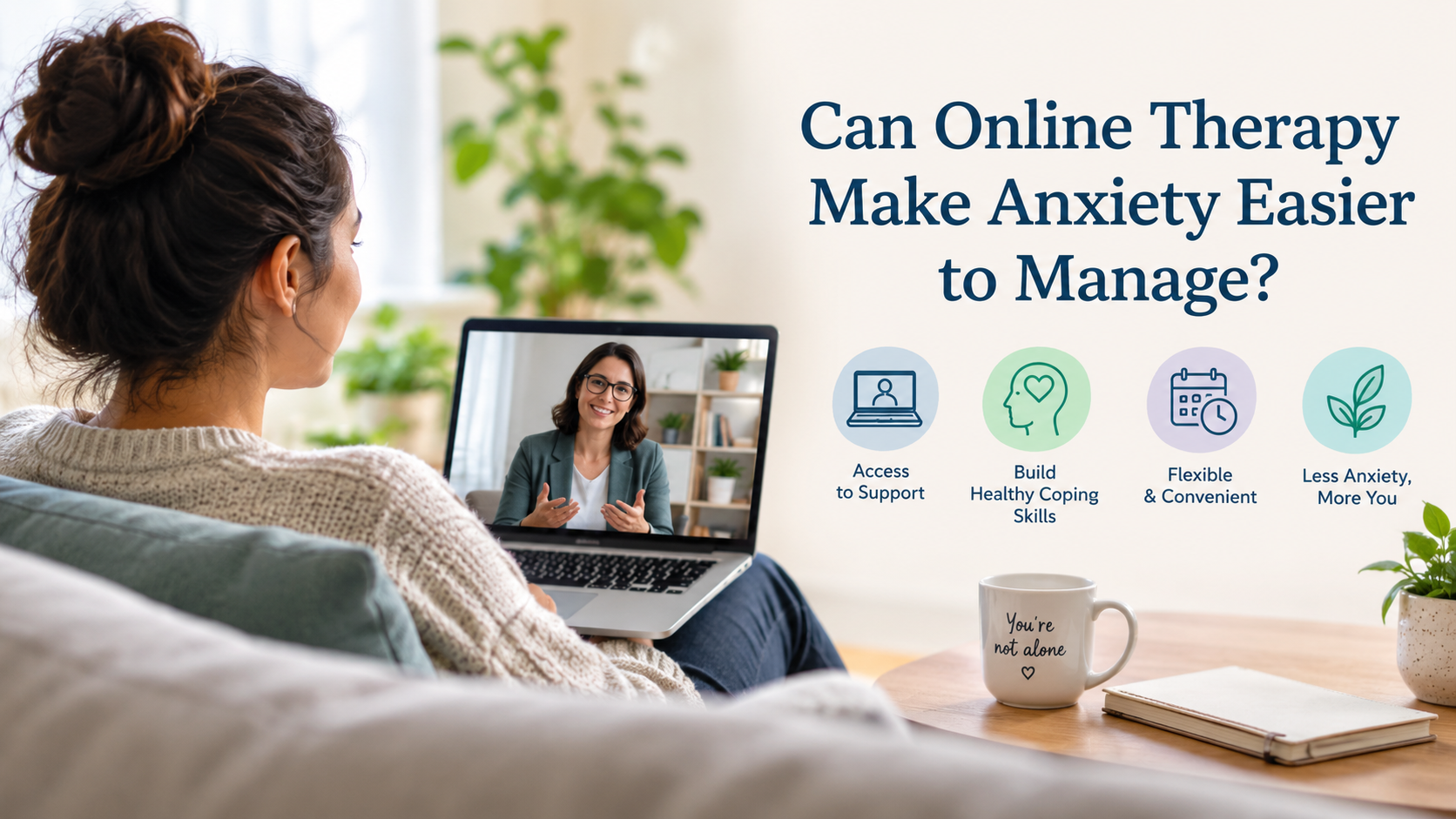
If you’ve ever considered online therapy, you’ve probably wondered:
Does virtual therapy actually work, or is it basically just talking to someone on Zoom?
It’s a fair question. For some people, sitting in a therapist’s office feels like the traditional, and maybe more legitimate, way to do therapy. The idea of doing therapy from your bedroom, office, or car can initially feel a little strange. For others, it is actually much more comfortable for them.
But virtual therapy isn’t simply a less convenient version of in-person therapy. For many people with anxiety, online therapy can be an effective and practical way to receive treatment.
What Is Online Therapy?
Online therapy, sometimes called virtual therapy or telehealth, allows you to meet with a licensed therapist through secure video sessions. The therapy itself doesn’t necessarily look dramatically different from in-person treatment. You can still talk through what’s going on, learn new skills, identify patterns, challenge unhelpful thinking, and work toward specific goals.
Depending on what you’re struggling with, treatment may include approaches such as:
Cognitive Behavioral Therapy (CBT)
Exposure-based therapy
Exposure and Response Prevention (ERP) for OCD
Behavioral strategies
Emotional regulation skills
Parent involvement for children and teens
The difference is simply where the session takes place. And sometimes, that difference can actually be helpful.
Why Virtual Therapy Can Work Well for Anxiety
One of the biggest benefits of virtual therapy is convenience. When you’re already overwhelmed, adding a commute to therapy can become one more obstacle.
Virtual therapy can make it easier to fit treatment into a busy schedule. You don’t have to worry about traffic, parking, arranging transportation, or rushing across town after work. But convenience isn’t the only benefit.
For anxiety treatment, being in your everyday environment can sometimes be an advantage. Anxiety doesn’t only happen in a therapist’s office.
It happens:
Before school in the morning
While sitting at your desk trying to work
In the grocery store
Before getting on a plane
When you’re lying awake at night
While checking your phone for reassurance
At home when you’re stuck in an OCD ritual
Virtual therapy can sometimes make it easier to connect treatment to real life.
You Can Practice Skills Where You Actually Need Them
One of the things I like about virtual therapy is that you aren’t always talking hypothetically about what happens outside of session. Sometimes we can work directly in the environment where the problem occurs.
For example, someone with anxiety may be able to practice:
Entering an anxiety-provoking situation while connected with their therapist Reducing avoidance in their own home
Working through panic-related fears
Practicing exposure exercises
Resisting OCD compulsions in the environment where they typically occur Using strategies in real time rather than trying to remember them later
This doesn’t mean every virtual therapy session involves doing something outside of your chair. But it does mean that virtual treatment can sometimes feel more connected to everyday life.
What About Exposure Therapy and ERP?
A common question is whether exposure therapy can really be done online. And the answer is Yes!!! I have had many patients complete exposure therapy
successfully using virtual therapy. In fact, virtual treatment can be particularly useful for certain types of exposure work.
Think about it: many fears and compulsions happen at home or in everyday environments, not inside a therapist’s office. Some fear can’t be replicated in the office, as well.
For someone with OCD, this might mean working on resisting a compulsion in the environment where it normally happens.
For someone with panic, treatment might involve learning to respond differently to physical sensations and gradually reducing avoidance.
For someone with social anxiety, virtual sessions might include practicing real world situations between sessions and processing what happened.
Exposure therapy isn’t about a therapist physically standing next to you while you face every fear. A large part of treatment is helping you build the confidence to eventually approach situations independently.
Virtual Therapy Can Make Specialized Treatment More Accessible
This is one of the biggest advantages, in my opinion. You may live in an area with plenty of therapists, but very few who specialize in what you’re actually dealing with. For example, many therapists treat “anxiety,” but fewer have specific training or experience treating OCD with ERP.
Virtual therapy can expand your options. Instead of limiting your search to therapists within a 15-minute drive, you may be able to work with a specialist anywhere within your state, depending on licensing requirements.
For people in Connecticut and New York, this can make specialized anxiety and OCD treatment much easier to access.

Is Online Therapy Better for People With Social Anxiety?
Sometimes, but it depends.
Virtual therapy can be a good starting point for someone who feels intimidated by the idea of walking into a therapist’s office. It can also make therapy more accessible for someone whose anxiety makes leaving the house difficult.
But I also think it’s important to be careful here. If someone has significant social anxiety, virtual therapy shouldn’t automatically become another way to avoid situations outside the home.
The goal isn’t to make your life smaller and simply find ways to avoid everything that feels uncomfortable. Sometimes virtual therapy can actually be used to help someone gradually work toward the things they’ve been avoiding.
And as I mentioned in my other blog posts, social anxiety isn’t always just about fear of judgment. Sometimes people are anxious in social situations because they genuinely don’t feel confident about what to say or how to navigate conversations. In those cases, therapy may need to include social skills and confidence-building, not just exposure.
Can Children and Teens Do Therapy Online?
Absolutely!
Many children and teens are already comfortable communicating through technology, and virtual therapy can make treatment more accessible for busy families. Parents don’t have to take as much time off work. Kids don’t have to leave school early to drive to an appointment. And therapy can happen in an environment where the child already feels comfortable. For younger children, parent involvement may be an important part of treatment.
Of course, virtual therapy isn’t the best fit for every child. Factors like age, attention span, privacy at home, technology access, and the child’s ability to engage through a screen should all be considered.
What If I Have ADHD or Trouble Paying Attention?
This is another question worth asking. Some people with ADHD worry that they won’t be able to focus during a virtual session. And honestly, sometimes sitting still and staring at a screen for an hour isn’t ideal for anyone.
A good therapist can make adjustments. Sessions don’t always have to look like two people sitting perfectly still and maintaining eye contact with a webcam. Depending on the person and their needs, therapy might include movement, visuals, interactive activities, screen sharing, written exercises, or more structured sessions. The format should work for the person, not the other way around.
Are There Downsides to Online Therapy?
Of course. Virtual therapy isn’t perfect for everyone. Some people simply prefer being in the same room as their therapist. Others have difficulty finding a private place at home to talk. Technology problems can be frustrating, and some concerns may require a higher level of care or services that are better provided in person.
It’s also important to make sure you’re working with a therapist who is appropriately licensed to provide services in the state where you’re physically located during the session.
The goal isn’t to convince everyone that virtual therapy is better than in-person therapy. It’s to recognize that both can be effective, and the right format depends on the individual.
How Do You Know If Online Therapy Is Right for You?
Virtual therapy may be worth considering if:
You have a busy schedule
Transportation or distance makes in-person therapy difficult
You want access to a specialist who isn’t located nearby
You feel comfortable communicating through video
You want to practice skills in your everyday environment
You are looking for treatment for anxiety, panic, OCD, or related concerns
But you don’t have to decide that virtual therapy is right for you before talking to someone. A consultation can help you ask questions about how sessions work and whether the format makes sense for your needs.
The Bottom Line
Online therapy isn’t just “regular therapy on a computer.”
For many people, virtual treatment offers flexibility, access to specialized care, and opportunities to connect therapy to real-life situations. For anxiety and OCD specifically, being able to practice skills and exposures in everyday environments can sometimes be a real advantage.
At the same time, virtual therapy isn’t the right fit for everyone, and that’s okay.
The most important thing is finding a treatment approach and therapist that makes sense for what you’re struggling with.
Looking for Virtual Anxiety or OCD Therapy?
I provide virtual therapy for children, teens, and adults throughout Connecticut and New York. My approach includes evidence-based treatment for anxiety and OCD, including CBT, exposure-based therapy, and ERP.
If you’re unsure whether virtual therapy is the right fit, or you’re not sure what type of support you need, my Care Navigation service can also help you think through your options and identify possible next steps.
Your cheerleader,
Andrea